SAVED
File name
.JPG
File alt. text
Image should be
px wide x
px tall.
Select Image
Select Image
L
O
G
I
N
EXISTING USERS
NEW USERS
password:
Forgotten your password?
password:
LOG IN
REGISTER
The Gastroenterology Training Handbook
For Specialist Registrars
HOME
OESOPHAGUS
•Gastro Oesophageal Reflux Disease
•Oesophageal Cancer
•Oesophageal Dysmotility
•Benign Oesophageal Lesions
•Miscellaneous
•Dysphagia
STOMACH
•Obesity Surgery
•Clinical Presentations of Gastric Conditions
•Gastric Cancer
•Gastric Polyps and Masses
•Peptic Ulcer Disease
•Gastritis and Gastropathy
•Miscellaneous
SMALL BOWEL
•Coeliac Disease
•Small Bowel Infections
•Small Bowel Masses
•Miscellaneous
COLON
•Colorectal and Anal Cancer
•Diagnostic Pathways for Colonic Disease
•Colonic Vascular Disorders
•Anal Diseases
•Various Colitides
•Colonic Motility Disorders
•Miscellaneous
•Colonic Infection
LIVER
•Alcohol
•Liver Failure
•Miscellaneous
•Ascites
•Bilirubin Metabolism
•Vascular Problems
•Clinical Presentations
•Liver Masses
•Hepatitis B
•Hepatitis C
•Autoimmune Conditions
•Metabolic Conditions
•Treatments
•Various Viruses
•Hepatopulmonary Disorders
•Liver Imaging
BILIARY
•Gallstone Disease
•Biliary Cancers
•Biliary Parasites
•Miscellaneous
NUTRITION
•Nutrition Therapy
•Minerals
•Proteins, Fats and Sugars
•Vitamins
•Clinical Conditions and Nutrition
PANCREAS
•Pancreatitis
•Pancreatic Masses and Cysts
•Pancreatic Cancers
•Other
IBD
•Epidemiology
•IBD Diagnosis
•Extra Intestinal Manifestations
•Surgery
•Treatment
MISCELLANEOUS
•Bleeding
•Rheumatological Disease
•Infection
•Vascular Lesions
•Other
home -
Stomach -
Gastric Polyps and Masses -
Carcinoid Endoscopy
search
Ask a question in the forum
Written by Dr Sebastian Zeki
MCQs for this page
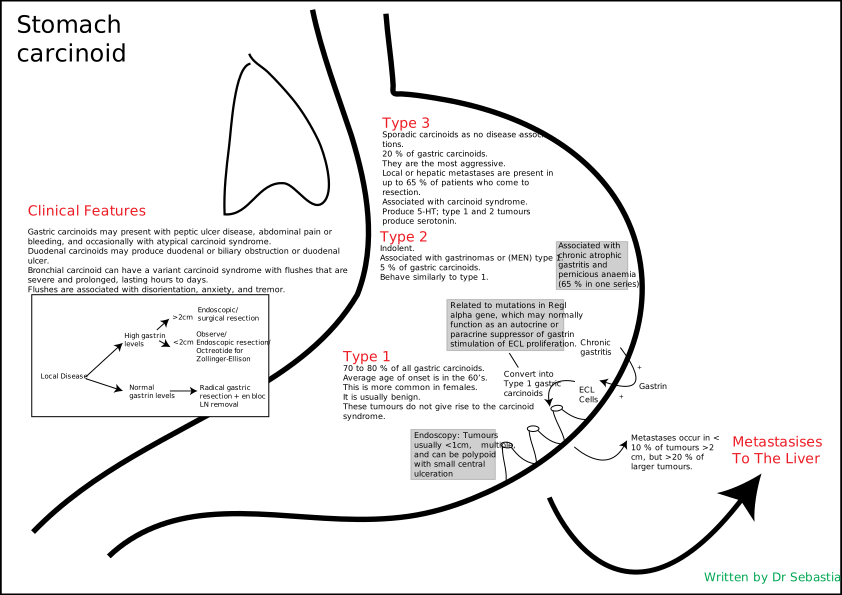
Carcinoid Endoscopy
View large version
Embed image
paste this code into your webpage / blog to share.
Clinical Features
Gastric carcinoids may present with peptic ulcer disease, abdominal pain or
bleeding, and occasionally with atypical carcinoid syndrome.
Duodenal carcinoids may produce duodenal or biliary obstruction or duodenal
ulcer.
Bronchial carcinoid can have a variant carcinoid syndrome with flushes that are
severe and prolonged, lasting hours to days.
Flushes are associated with disorientation, anxiety, and tremor.
+
+
Related to mutations in Regl
alpha gene, which may normally
function as an autocrine or
paracrine suppressor of gastrin
stimulation of ECL proliferation.
Associated with
chronic atrophic
gastritis and
pernicious anaemia
(65 % in one series).
Type 1
70 to 80 % of all gastric carcinoids.
Average age of onset is in the 60’s.
This is more common in females.
It is usually benign.
These tumours do not give rise to the carcinoid
syndrome.
Type 3
Sporadic carcinoids as no disease associa
-
tions.
20 % of gastric carcinoids.
They are the most aggressive.
Local or hepatic metastases are present in
up to 65 % of patients who come to
resection.
Associated with carcinoid syndrome.
Produce 5-HT; type 1 and 2 tumours
produce serotonin.
Endoscopy: Tumours
usually <1cm, multiple,
and can be polypoid
with small central
ulceration
Type 2
Indolent.
Associated with gastrinomas or (MEN) type 1.
5 % of gastric carcinoids.
Behave similarly to type 1.
Local Disease
High gastrin
levels
Normal
gastrin levels
Radical gastric
resection + en bloc
LN removal
<2cm
>2cm
Endoscopic/
surgical resection
Observe/
Endoscopic resection/
Octreotide for
Zollinger-Ellison
Metastasises
To The Liver
Metastases occur in <
10 % of tumours >2
cm, but >20 % of
larger tumours.
Convert into
Type 1 gastric
carcinoids
Chronic
gastritis
Gastrin
ECL
Cells
Stomach
carcinoid
Written by Dr Sebastian Zeki
Related Stories
•
•
•
•
•