SAVED
File name .JPG
File alt. text
Image should be px wide x px tall.
Select Image
home - Stomach - Gastric Cancer - Early Gastric Cancer Written by Dr Sebastian Zeki

Early Gastric Cancer

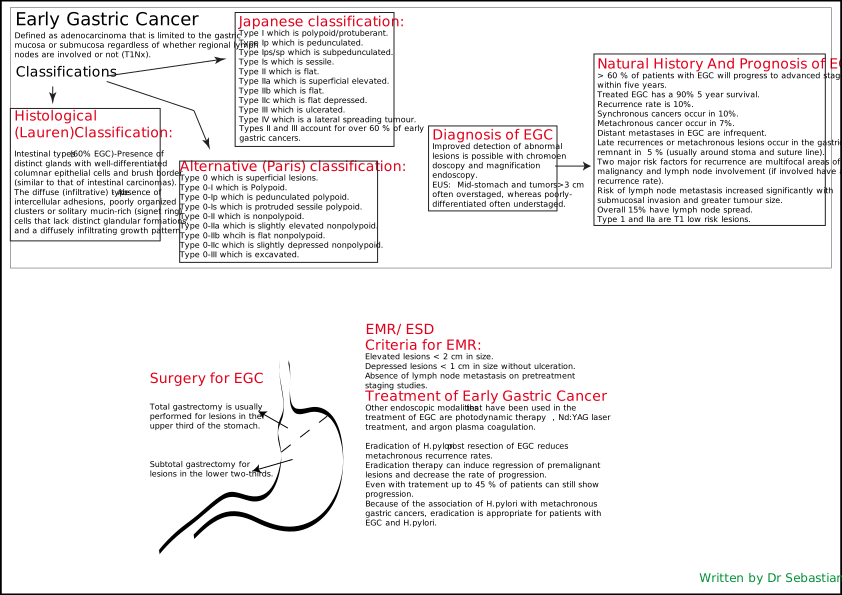
Defined as adenocarcinoma that is limited to the gastric mucosa or submucosa regardless of whether regional lymph nodes are involved or not (T1Nx). Early Gastric Cancer Natural History And Prognosis of EGC > 60 % of patients with EGC will progress to advanced stage disease within five years.Treated EGC has a 90% 5 year survival.Recurrence rate is 10%.Synchronous cancers occur in 10%.Metachronous cancer occur in 7%.Distant metastases in EGC are infrequent.Late recurrences or metachronous lesions occur in the gastric remnant in 5 % (usually around stoma and suture line).Two major risk factors for recurrence are multifocal areas of malignancy and lymph node involvement (if involved have a 6% recurrence rate).Risk of lymph node metastasis increased significantly with submucosal invasion and greater tumour size.Overall 15% have lymph node spread. Type 1 and IIa are T1 low risk lesions. Treatment of Early Gastric CancerOther endoscopic modalities that have been used in the treatment of EGC are photodynamic therapy , Nd:YAG laser treatment, and argon plasma coagulation.Eradication of H.pylori post resection of EGC reduces metachronous recurrence rates.Eradication therapy can induce regression of premalignant lesions and decrease the rate of progression.Even with tratement up to 45 % of patients can still show progression.Because of the association of H.pylori with metachronous gastric cancers, eradication is appropriate for patients with EGC and H.pylori. Diagnosis of EGCImproved detection of abnormal lesions is possible with chromoen-doscopy and magnification endoscopy.EUS: Mid-stomach and tumors>3 cm often overstaged, whereas poorly-differentiated often understaged. Histological (Lauren)Classification:Intestinal types (60% EGC)-Presence of distinct glands with well-differentiated columnar epithelial cells and brush border (similar to that of intestinal carcinomas).The diffuse (infiltrative) type- Absence of intercellular adhesions, poorly organized clusters or solitary mucin-rich (signet ring) cells that lack distinct glandular formations, and a diffusely infiltrating growth pattern Alternative (Paris) classification:Type 0 which is superficial lesions.Type 0-I which is Polypoid.Type 0-Ip which is pedunculated polypoid.Type 0-Is which is protruded sessile polypoid.Type 0-II which is nonpolypoid.Type 0-IIa which is slightly elevated nonpolypoid.Type 0-IIb whcih is flat nonpolypoid.Type 0-IIc which is slightly depressed nonpolypoid.Type 0-III which is excavated. Surgery for EGCTotal gastrectomy is usually performed for lesions in the upper third of the stomach.Subtotal gastrectomy for lesions in the lower two-thirds. Criteria for EMR:Elevated lesions < 2 cm in size.Depressed lesions < 1 cm in size without ulceration.Absence of lymph node metastasis on pretreatment staging studies. EMR/ ESD Classifications Japanese classification:Type I which is polypoid/protuberant. Type Ip which is pedunculated.Type Ips/sp which is subpedunculated.Type Is which is sessile.Type II which is flat.Type IIa which is superficial elevated.Type IIb which is flat.Type IIc which is flat depressed.Type III which is ulcerated.Type IV which is a lateral spreading tumour. Types II and III account for over 60 % of early gastric cancers. Written by Dr Sebastian Zeki

Related Stories

The changing landscape of gastrointestinal cancers in India: An analysis involving published data from Cancer Incidence in Five Continents of 2013-2017 compared to 1988-1992

Robotic portomesenteric vein reconstruction using self-fashioned bovine pericardial grafts during Da Vinci-assisted pancreatectomy: a case series with video demonstration

Perioperative autonomic recovery and inflammatory resolution are associated with early molecular residual disease and survival after curative gastric and colorectal cancer surgery in older adults: a prospective cohort study

Delayed gastric emptying after robot-assisted pancreatoduodenectomy: the Transatlantic Robot Pancreas Consortium (TROPANC)

Association between postoperative Clostridioides difficile infection and outcomes following pancreatoduodenectomy for pancreatic cancer: a national cohort study